
Rauh Jewish Archives at the Heinz History Center
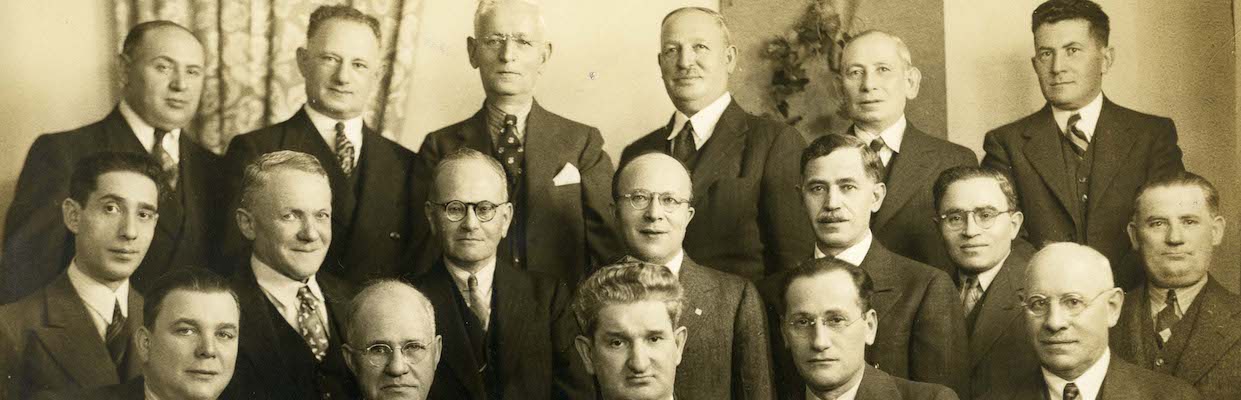
The Workmen’s Circle, or Arbiter Ring, was an international Jewish welfare organization associated closely with the labor movement. It was founded in New York City in 1900 and expanded to include branches all over the world, including a large presence in Western Pennsylvania. Workmen’s Circle came to Western Pennsylvania around 1904 with the formation of Branch 45 in Pittsburgh. At its peak in the early 20th century, Workmen’s Circle operated at least 11 branches in Western Pennsylvania—Branch 45, Branch 104, Branch 250, Branch 932, and Branch 975 in Pittsburgh, Branch 158 in Altoona, Branch 161 in Monessen, Branch 416 in Wheeling, W.V., Branch 431 in East Pittsburgh, Branch 617 in Beaver Falls, as well as a branch in New Kensington—and maintained some presence in other small towns throughout the region. Workmen’s Circle also operated at least two cemeteries in the region: the Branch 45 cemetery in Shaler Township and the joint Branch 932/Branch 975 cemetery in Reserve Township. The Jewish Cemetery and Burial Association currently oversees both cemeteries.
Eager to have a physical meeting place, the Workmen’s Circle sponsored the creation of the Labor Lyceum. The four-story building opened in 1916 on Miller Street in the Hill District. It served as the offices of the local Workmen’s Circle as well as many Jewish labor unions, Jewish political parties and Jewish cultural organizations. Propelled in part by the opening of the building, Pittsburgh was selected as the site of the national Workmen’s Circle convention in early 1918, bringing thousands to the city. The Labor Lyceum was the home for the Workmen’s Circle until the building was sold in 1930.
Although not a labor union itself, the Workmen’s Circle was supportive of the labor movement and was often involved in labor advocacy. It assisted efforts to organize Jewish stogy makers, garment workers, and bakers in the early 20th century. It also participated in labor activities involving non-Jews, including miners and steel workers. With the rise of Nazism in the early 1930s, the Workmen’s Circle became a supporter of the Pittsburgh Jewish Labor Committee, which organized against Nazi activities.
The Workmen’s Circle also organized fundraising efforts. It was a consistent contributor to Jewish War Relief efforts in Europe during World War I. In the early years of the Great Depression, the local Workmen’s Circle branches created a loan association.
The local presence of the Workmen’s Circle declined in the second half of the 20th century, consolidating down to Branch 45. The branch continued to support progressive causes while also maintaining its sponsorship of Yiddish cultural activities in the city. Workmen’s Circle Branch 45 officially disbanded in 1983.
Bibliography
Rauh Jewish Archives
- Workmen’s Circle 45 records [MSS 291] (catalog record).
- Workmen’s Circle 45 photographs [MSQ 291] (catalog record).
- Workmen’s Circle banner [mus 88.2]
- Workmen’s Circle Branch 45 50th Anniversary Celebration program, from Jewish Archival Survey [MSS 196] (online).
- Workmen’s Circle 45 and 975 cemeteries photographs, from Gerald Sapir Papers and Photographs [MSS 775] (online).
- Zeilic Gheltman papers [2004.0116] (catalog record).
- Bess Topolsky, Lillian Horwitz and Corinne Krause oral history, 1982 [CSS 2] (catalog record).
- Bess Topolsky oral history, 1983 [MFF 4917] (catalog record).
- Hurwitz, Maximilian. ” The Workmen’s Circle; its history, ideals, organization and institutions,” New York, The Workmen’s Circle, 1936. [HD7126 .H85] (catalog record).
- “Fertsiòk yor Arbeòter ring: a geshikhòte in bilder,” 1940 [E184 .J5 K15 f] (catalog record).
- Shapiro, Judah J. “The friendly society: a history of the Workmen’s Circle,” New York, Media Judaica, 1970. [E184 .J5 S529] (catalog record).
- Feldman, Jacob. “The Jewish Experience in Western Pennsylvania,” Pittsburgh: Historical Society of Western Pennsylvania, 1986 (catalog record).
University of Pittsburgh Archives & Special Collections
- Sam Dizenfield oral history, 1969, from National Council of Jewish Women, Pittsburgh Section Records [AIS1664.40] (online).
- Philip Ellovich oral history, 1969, from National Council of Jewish Women, Pittsburgh Section Records [AIS1664.40] (online).
- Leah Katz oral history, 1968, from National Council of Jewish Women, Pittsburgh Section Records [AIS1664.40] (online).
- Hymen Richman oral history, 1986, from National Council of Jewish Women, Pittsburgh Section Records [AIS1664.40] (online).
- Etta Roscow Moscov oral history, 1969, from National Council of Jewish Women, Pittsburgh Section Records [AIS1664.40] (online).
- Pearl Rothbart oral history, 1969, from National Council of Jewish Women, Pittsburgh Section Records [AIS1664.40] (online).
- Harry Schweitzer oral history, 1968, from National Council of Jewish Women, Pittsburgh Section Records [AIS1664.40] (online).
- Eddie Steinfeld oral history, 1984, from National Council of Jewish Women, Pittsburgh Section Records [AIS1664.40] (online).
- Belle Swartz oral history, 1969, from National Council of Jewish Women, Pittsburgh Section Records [AIS1664.40] (online).
- Bess Topolsky oral history, 1968, from National Council of Jewish Women, Pittsburgh Section Records [AIS1664.40] (online).
- Bess Topolsky oral history, 1987, from National Council of Jewish Women, Pittsburgh Section Records [AIS1664.40] (online).
- Nathan Weiner oral history, 1968, from National Council of Jewish Women, Pittsburgh Section Records [AIS1664.40] (online).
Carnegie Mellon University
- Scoratow, Leon B. “The Arbiter Ring, the Growth and Decline of the Socialist Labor Movement in the Pittsburgh Jewish Community 1904-1947,” The Sloping Halls Review, 1997 (online)
Exhibit History
- Author: Eric Lidji
- Created: July 14, 2022
- Current: July 14, 2022