
Rauh Jewish Archives at the Heinz History Center
The city of Pittsburgh annexed several independent communities on the south shore of the Monongahela River in 1872, creating a section of the city known broadly as the South Side. The South Side of Pittsburgh today includes several neighborhoods, including the South Side Flats, the South Side Slopes, and the “Hilltop” neighborhoods of Allentown, Arlington, Arlington Heights, Beltzhoover, Knoxville, Mt. Oliver, and Mount Washington, and beyond to include Brookline, Beechview, Carrick, and Overbrook. These neighborhoods toward comprise Ward 16, 17, 18, 19, 29, 30, and 32 of Pittsburgh.
The earliest Jewish settlement in the South Side Flats dates to the late 1850s and early 1860s, when Jewish merchants opened dry goods and clothing stores along East Carson Street. Among these early merchants were Moses Frank, Henry Silverman, and Samuel Prager. Jacob and Isaac Kaufmann started J. Kaufmann & Brother men’s store in the neighborhood in 1871 before opening their department store in downtown Pittsburgh. [1]Feldman, Jacob. “The Jewish Experience in Western Pennsylvania,” Pittsburgh: Historical Society of Western Pennsylvania, 1986, page 24 (catalog record).
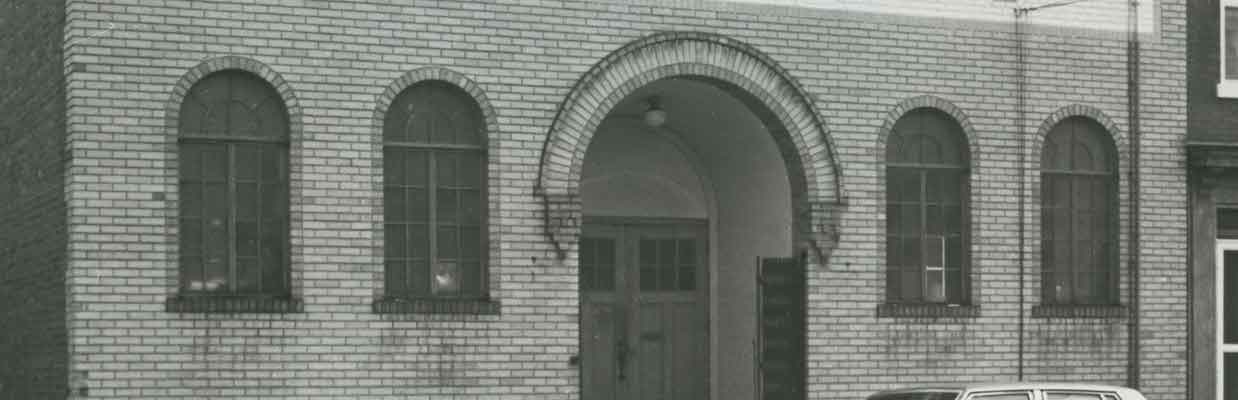
Into the first years of the 20th century, Jewish families living in the South Side Flats generally affiliated with existing congregations and Jewish organizations in the city. The growth of the Jewish population of the neighborhood in the first decade of the 20th century led to the creation of local Jewish institutions. The B’nai B’rith Birmingham Lodge No. 609 was formed in 1907, followed by a National Council of Jewish Women-sponsored neighborhood religious school in 1911, and eventually the formation of Congregation Talmud Torah in late 1913. Talmud Torah dedicated a synagogue building at a storefront at 1908 Sarah Street in 1917 and built a new synagogue at the same location in 1930. The congregation soon established a Hebrew school, as well as a Sisterhood.
The Jewish population of the South Side Flats and South Side Slopes was heavily concentrated along East Carson Street with a few families living in the South Side Slopes. Based on the limited population data available, the Jewish residential population of the Ward 16 and Ward 17 appears to have peaked in the late 1920s. Throughout the 1920s, 1930s, and 1940s, Jewish families in the South Side increasingly relocated to Squirrel Hill and the East End. By the early 1960s, there were less than 10 known Jewish households living in the South Side Flats and South Side Slopes.[2]Talmud Torah Sisterhood membership, 1921 (online). [3]Kuntz, Leonard. “The Changing Pattern of the Distribution of the Jewish Population of Pittsburgh From Earliest Settlement to 1963,” 1970 (online—LSU Digital Commons). [4]“Shifts in Jewish Children Population: 1924-1958,” from Hebrew Institute Records [MSS 512] (online).
Bibliography
Historic Pittsburgh
Maps
- 1872 – Atlas of the cities of Pittsburgh, Allegheny, and the adjoining boroughs (online—Historic Pittsburgh).
- 1882 – Atlas of the cities Pittsburgh and Allegheny (online—Historic Pittsburgh).
- 1890, Volume 5 – Atlas of the city of Pittsburgh: Wards 24-36 (online—Historic Pittsburgh).
- 1901, Volume 4 – Real estate plat-book of the City of Pittsburgh : Wards 24-36 (online—Historic Pittsburgh).
- 1916, Volume 6 (Revised 1922 and 1928) – Plat-book of the city of Pittsburgh : South Side and Southern Vicinity of Pittsburgh (East Half) (online—Historic Pittsburgh).
- 1917, Volume 7 (Revised 1928) – Plat-book of the city of Pittsburgh : South Side and Southern Vicinity of Pittsburgh (West Half) (online—Historic Pittsburgh).
- 1934, Volume 9 (Revised 1940) – Plat-book of the city of Pittsburgh (South Side and Southern Vicinity of Pittsburgh): Wards 9-11, 14 and 15 (online—Historic Pittsburgh).
- “An atlas of the South Side neighborhood of Pittsburgh 1977,” Pittsburgh Neighborhood Alliance (online—Historic Pittsburgh).
Rauh Jewish Archives
- “Talmud Torah Sisterhood,” Pittsburgh Jewish Community Book (1921) (online—Historic Pittsburgh).
- “Agudath Kehillath,” Pittsburgh Jewish Community Book (1921) (online—Historic Pittsburgh).
- Arnfeld, Ruth. “A Half Century of Faith,” Jewish Criterion, Sept. 11, 1942 (online).
University of Pittsburgh Archives & Special Collections
Oral histories
- Maurice Goldstein oral history (1987), Tape 1, Side 1, from NCJW-Pittsburgh Records, University of Pittsburgh Archives & Special Collections [pitt:ais196440.168_t1s1] (online—Historic Pittsburgh).
Exhibit History
- Author: Eric Lidji
- Created: October 15, 2023
- Current: October 15, 2023
References
| ↑1 | Feldman, Jacob. “The Jewish Experience in Western Pennsylvania,” Pittsburgh: Historical Society of Western Pennsylvania, 1986, page 24 (catalog record). |
|---|---|
| ↑2 | Talmud Torah Sisterhood membership, 1921 (online). |
| ↑3 | Kuntz, Leonard. “The Changing Pattern of the Distribution of the Jewish Population of Pittsburgh From Earliest Settlement to 1963,” 1970 (online—LSU Digital Commons). |
| ↑4 | “Shifts in Jewish Children Population: 1924-1958,” from Hebrew Institute Records [MSS 512] (online). |