
Rauh Jewish Archives at the Heinz History Center
Ebensburg is a borough in Cambria County. It was settled in the late 18th century, chosen as a the county seat for Cambria County a few years later, and incorporated in 1825.
Covitch
Mandel Aron and Pearl Yutcovitch immigrated to the United States from Hungary. They had at least eight children. Their three sons all started stores in small towns throughout Cambria County—Ben in Hastings, Barney in Cassandra, and Jacob in Ebensburg.
Jacob Covitch (1889-1961) and Mary (Grossman) Covitch relocated to Ebensburg from Cresson in 1923 and started the J. Covitch Clothing Store on High Street. They expanded the store in 1932. A fire on the block in 1947 damaged some of the stock in the Covitch store. In 1932, Jacob Covitch secured a patent for a new type of merchandise tag that did not damage clothing.
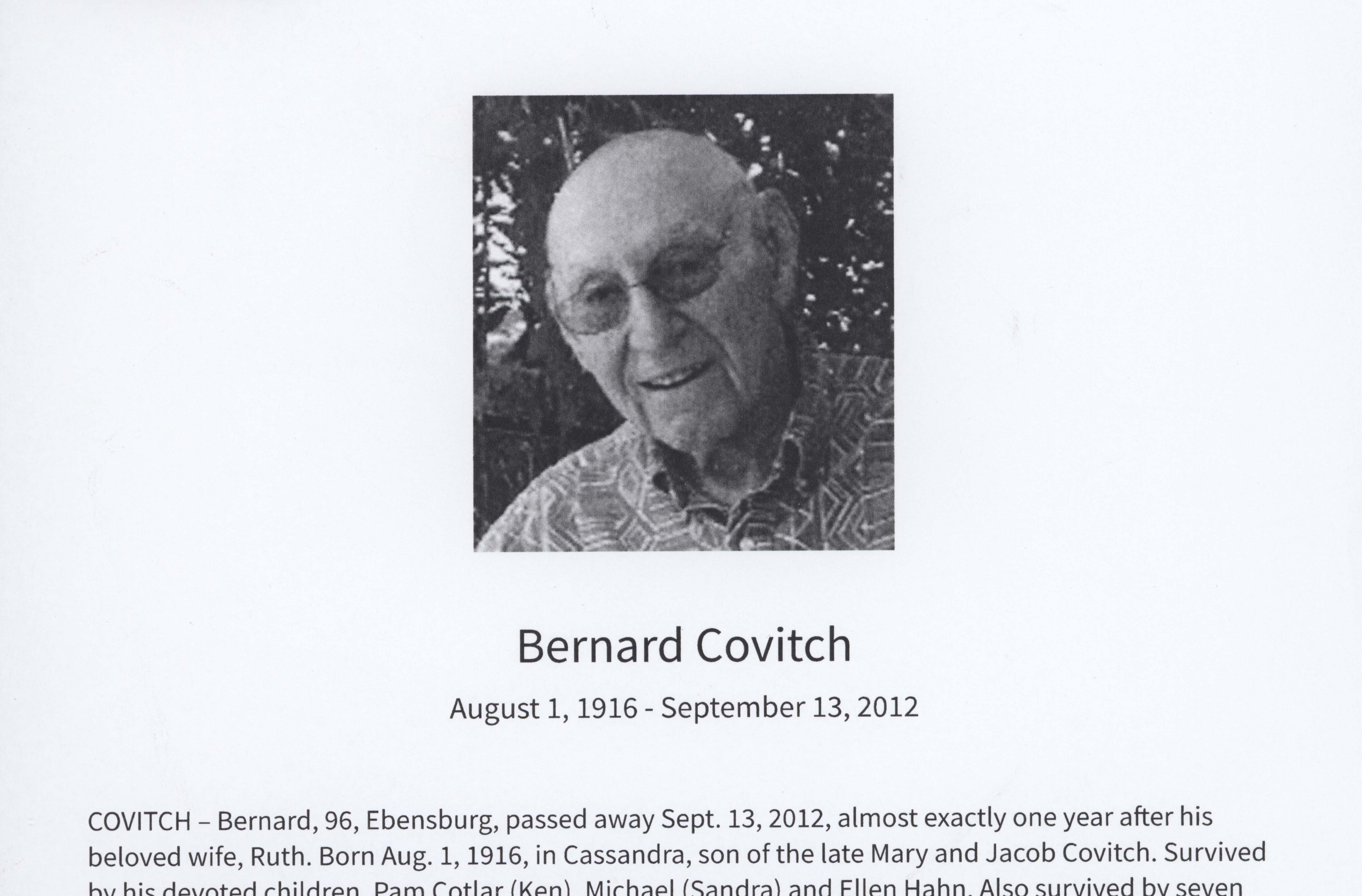
Jacob and Mary Covitch had three sons, Bernard, Nathan, and Judah. Bernard remained in Ebensburg and joined the family business, which subsequently became J. Covitch & Son. Nathan went into business in Lewistown. Judah died of an illness in a military training camp during World War II. The family named a dormatory at Penn State University in his memory in 1950.
The Covitch family were members of Agudath Achim Congregation of Altoona. Following the death of Jacob Covitch in 1961, several of his friends in the community donated books with Jewish themes to the Ebensburg Free Public Library in his memory.
Shadden
Barney Shadden (1866-1941) immigrated to the United States from the Russian Empire in the early 1880s. He lived in Baltimore, Md. before coming to Western Pennsylvania. He was living in Altoona, Pa. by 1900 and by 1910 had moved to Twin Rocks, Pa. (Expedit) in Blacklick Township, where he started a store. With his wife Sara Mary Shadden, he had eight children: Jacob, Jeannette Newman, Ida Kleinstub, Isidore/Isaac, Louis, Maurice, Edward, and Edith.
Edward Shadden graduated from Ebensburg High School and the University of Michigan. He acquired Wayne’s Ladies’ Shoppe from Maurice Wayne of Altoona in August 1933 and started Shadden’s department store on West High Street. The store also had a branch in Nanty Glo.
Pearle
Dr. Merle R. Pearle was an officer and pilot in the Army Air Corps, serving in North Africa during World War II. He opened an optometry practice in Ebensburg in 1949. His wife Ruth (Goodman) Pearle earned a master’s degree in Social Work at the University of Chicago. She taught at St. Francis College. She was appointed president of the Cambria County Mental Health Council and later a state council. They had four children, James, Jacquelyn, Phyllis, and Margaret. The family was affiliated with Beth Zion Congregation in Johnstown.
Faden
Dr. Gerson Faden (1909-1996) was born in Chicago to immigrant parents from the Russian Empire. He enlisted in the U.S. military in the late 1930s. He married Helen Alexander of Harrisburg, Pa. in December 1941. No later than 1949, they were living in Ebensburg, where Dr. Faden opened a general practice. They were both active in civic life. They later retired to Florida sometime after 1961 but were buried in the Rodef Sholom Cemtery in Geistown, Pa.
Bankin
Samuel Bankin (1892-1982) immigrated to the United States from Slonim in present-day Belarus around 1902. After living for a time in the town of Bertha in Washington County, he settled in Cambria County. With his wife Ethel (Weiner) Bankin, he had a daughter Myra June (1917).
By the 1930 census, Bankin was managing the Revloc Supply Company in the unincorproated town of Revloc just outside Ebensburg. The Revloc Supply Co. had been incorporated in October 1917 as the company store for J. H. Weaver & Co. At the time, state law required companies and their stores to file separate incorporation documents. A $30,000 building was constructed in Revloc in 1918. The store also served as the town postoffice, and Bankin was appointed postmaster for Revloc in 1931. He was an officer for the Revloc Baseball Club throughout the 1930s and later for the Ebensburg Country Club. He was also active in Kiwanis.
When the Bethlehem Steel Co. acquired various Pennsylvania coal companies in the late 1940s, it planned to close the associated company stores as part of an effort to divest itself of mercantile concerns. Among those marketted for sale were the Revloc Supply Company in Revloc and the Heisey Store in Nanty Glo. In January 1950, Bankin acquired both stores and their buildings.
Institutions
The Pennsylvania Department of Human Services opened the Ebensburg State School and Hospital in 1957 on the grounds of a former orphanage in Ebensburg. A second phase opened in 1963. The name was changed to Ebensburg Center in the late 1970s. The school initially admitted people with epilepsy and later people with intellectual disabilities. By the early 1970s, Rabbi Leib Heber was regularly visiting Ebensburg Center to assist Jewish people living there.
Bibliography
Rauh Jewish Archives
- Ebensburg materials, from Barry Rudel Papers [MSS 1394] (catalog record).
Detre Library & Archives
- Huber, Dave. “Historic Ebensburg,” Ebensburg, PA : Mountaineer-Herald, 1996- [F157 .C19 E34 1966] (catalog record).
- Bob Nelkin collection of ACC-PARC records [MSS 1002] (catalog record).
Lehigh University Archives & Special Collections
- Bethlehem Steel Corporation and Subsidiary Companies History – Volume 3 (online).
Exhibit History
- Author: Eric Lidji
- Created: August 17, 2026
- Current: August 17, 2026
Acknowledgements
- This entry was made possible through a grant from the United Jewish Federation of Johnstown, Beth Sholom Congregation, and the David A. Glosser Foundation.