
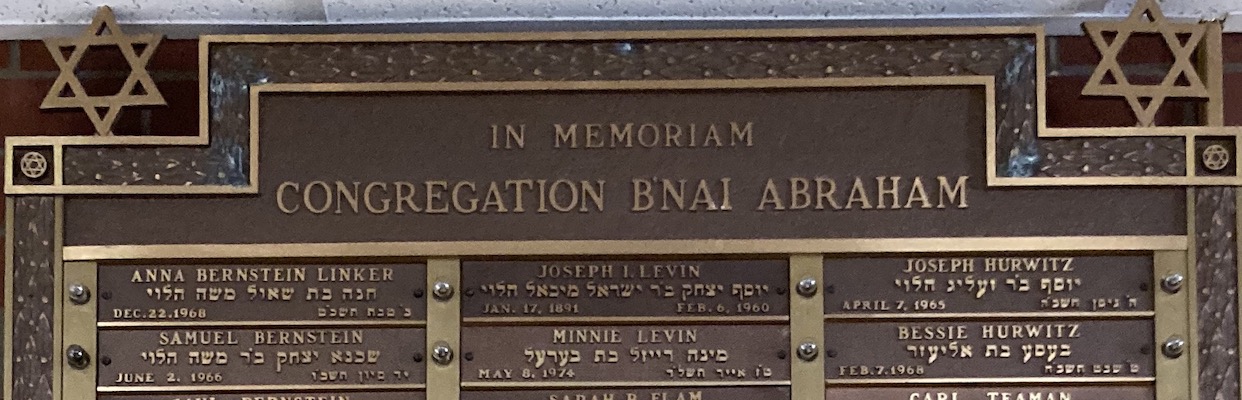
Butler is the county seat of Butler County. It was settled in 1803, incorporated as a borough in 1817, and incorporated as a city in 1918. The area grew quickly through the latter half of the 19th century with the development of natural resources in the area, including oil and gas, coal, and limestone, as well as numerous agricultural products.
By the mid-19th century, Butler was attracting Jewish peddlers. The earliest known Jewish residents of Butler were the Rosenthals, who had a store in town. Their son-in-law Mark Schneiderman came to Butler from Pittsburgh in 1858. The Zimmerman family opened Ritter and Ralston Dry Goods in Butler in 1867. By the early 1890s, Butler had a small settlement of Jews, many with roots in Germany and Hungary. Among these early Jewish settlers in the area were Abe Cohn, Julius Kaufmann, Max Nast, the Rosenberg family, Philip Schaul, Max Schloss, Leon Schloss, Adolf Steele, and the Trexler (Traxler) family. The Horwitz family came to the Butler area in the late 1890s to open a general store and later eventually started Keystone Pipe and Supply Company. The Freidman family started a meat market in 1900 that expanded into a popular chain of grocery stores.
The opening of the Standard Steel Car Company in 1902 attracted thousands to Butler and the neighborhood of Lyndora at the edge of the factory. The population increase attracted Jewish merchants who started clothing stores, grocery stores, and scrap metal businesses. Joseph Eskovitz started a bank and travel agency in Lyndora. His business promoted Jewish and non-Jewish settlement in Butler by arranging remittances between locals and their family members in Europe and by booking travel to the United States.
In 1903, the Jewish population of Butler hired Rev. Abraham H. Goodman as a cantor, teacher, shochet (ritual slaughterer), and mohel (ritual circumciser) and held High Holiday services that fall on the third floor of the Knights of Pythias Hall. In March 1906, the Jewish community incorporated B’nai Abraham Congregation with 13 charter members. B’nai Abraham opened a cemetery at the edge of town as early as January 1908. Morris Tafel of the Saxonburg Mineral Springs Hotel in nearby Saxonburg, Pa. donated property on Fifth Avenue in Lyndora for a future synagogue. Through communal fundraising efforts and a bond issued by Levi M. Wise, the non-Jewish owner of the Butler Eagle, B’nai Abraham dedicated a synagogue in 1911. A mikvah (ritual bath for women) was installed in the “Hoffman House” behind the synagogue around this time.
During the interwar years, the Jewish population of Butler peaked. Approximately half of the downtown businesses were Jewish-owned, according to one estimate. Some of the Jewish families in Lyndora during this era were Abes, Ackerman, Arnovitz, Baron, Barron, Bernstein, Brier, Garber, Goodman, Green, Hoffman, Horwitz, Hurwitz, Miller, Mintz, Offstein, Peck, Rosen, Rosenberg, Rossen, Rudolph, Silverman, Spector, Stern, Tischler, Zaritsky, Ziman, and Zuckerman. The B’nai Abraham synagogue became a central gathering spot for the community, hosting classes, lectures, dinners, dances, theatrical events, and fundraisers, in addition to prayer services and religious school.
By the late 1940s, the Jewish population of Butler was increasingly moving away from Lyndora and into the city center. B’nai Abraham sold its synagogue to Church of the Nazarene and looked for a new location. It purchased the Edward Reiber Home at East Fulton and Main Street in 1948 but determined the property was insufficient for its needs. It purchased the W. J. Brandon Home in 1954 and began construction on a synagogue and social hall addition, converting the original home into a religious school as the William Horwitz Education Center. The new structure was dedicated on Nov. 18, 1956.
During these years, B’nai Abraham modified its service. Initially an Orthodox congregation, it added a choir and an organ in the late 1940s and early 1950s. With the move to the new synagogue, it adopted mixed seating and for a time alternated between Conservative and Reform liturgy for use in different services. Through a modernization campaign in the 2010s, the sanctuary was remodeled to create an office wing.
ORGANIZATIONS
The B’nai B’rith Butler Lodge No. 772 was installed in July 1915. It was renamed the Nathan H. Zeffe Lodge No. 772 in 1948 after a local Jewish veteran of World War II.
The Butler Chapter of Hadassah was founded as early as 1919.
The Butler Council of Jewish Women began in the 1920s to support B’nai Abraham Congregation and to strengthen connections between the Jewish community and its neighbors in Butler County. It evolved into the congregational Sisterhood in the 1950s.
The Butler Jewish Welfare Fund was started in the late 1930s to provide for local, national, and international Jewish causes, including the United Jewish Appeal.
Some 73 members of the Jewish community of Butler served during World War II. To maintain contact between the soldiers and their families back home in Butler, the Jewish community created the MANAC News (Marines, Army, Navy, Air Corps).
YOUTH
By the time B’nai Abraham opened its synagogue in 1911, it had a small cheder (religious school) for local Jewish children. The school met daily after school with additional classes on Friday nights, Saturday mornings, and Sunday mornings. At various points in its existence, the B’nai Abraham religious school was affiliated with the Southwestern District of Pennsylvania Jewish Religious Schools program.
Butler briefly hosted a Young Men’s and Women’s Hebrew Association on Main Street, sponsoring debates among Jewish youth in the community. The Jewish community sponsored a Boy Scouts troop from the 1920s into the 1950s and a Girl Scouts troop in the 1940s. At various points in the first half of the 20th century, Butler was home to a Junior Hadassah chapter and a Junior Council of Jewish Women section. By the 1950s onward, the leading Jewish youth groups were AZA and BBG chapters organized through the Northwest Pennsylvania Council of the B’nai B’rith Youth Organization.
FAMILIES
Surnames found in the B’nai Abraham Cemetery include Aaron, Abbatiello, Abes, Adelson, Apple, Arnovitz, Baron, Barron, Berland, Berman, Bernstein, Bick, Black, Blank, Brier, Brown, Carl, Clug, Cohen, Cohn, Daly, Davis, Eisenberg, Feldblum, Feldman, Feldstein, Friedlander, Friedman, Frishman, Garber, Garbuny, Gluckman, Goldsmith, Goldstein, Goodman, Gould, Green, Greenberger, Gross, Grossman, Gruskin, Hoffman, Horewitz, Hornitz, Horwitz, Hurwitz, Israel, Jaffe, Jeremitto, Kass-Gerji, King, Klinger-Cohen, Kranick, Krause, Kuhr, Leavitt, Leefer, Leventhal, Levine, Linker, Lipsky, London, Marcus, Mark, Marks, Mattock, Mendicino, Metzger, Miller, Mintz, Much, Nast, Novick, Offstein, Paradise, Peck, Peritz, Pollack, Porges, Rapaport, Rapoport, Robins, Rocholovitz, Rodgers, Rose, Rosen, Rosenberg, Rosenblum, Rosenthal, Rossen, Ruben, Rubin, Rudoff, Schreiberg, Schrieberg, Schwob, Siev, Silverman, Simon, Simor, Smulovitz, Spokane, Stein, Stern, Stone, Taub, Teaman, Tishler, Touber, Toubert, Tyrnauer, Weinberg, Weinstein, Wohl, Zamoski, Zaritsky, Zaritzky, Zeefe, Ziman, Zucker, and Zuckerman.
POPULATION
SPIRITUAL LEADERS
Spiritual leaders of B’nai Abraham include Rev. Abraham H. Goodman (1903-1932), Rabbi Simon April (1932-c1944), Rabbi Robert Syme (1947-c1953), Rabbi Milton R. Rube, Rabbi Jerome Bass, Rabbi Joel Dubin, Rabbi Marvin Goldson, Rabbi Louis Cassil (1964-1967), Rabbi Barry Rosen, Rabbi Eliezer Ben Yehuda (1970-1984), Cantor Walter Boninger (1984-1999), Rabbi Hazzan Adriane Caplowe (1999-2008), Cantor Gary Gelender (2009), and Cantor Michal Gray-Schaffer (2011-2024).
Bibliography
Rauh Jewish Archives
Collections
- Congregation B’nai Abraham (Butler, Pa.) Records [MSS 1347]
- Congregation B’nai Abraham (Butler, Pa.) newsletter (catalog record).
- Butler Jewish Community materials from Synagogue Documentation Project records [MSS 317] (catalog record).
- Butler Jewish Community materials from Synagogue Documentation Project photographs [MSSP 317] (catalog record).
- History of the Butler (Pa.) Jewish Community [1999.0054] (catalog record).
- Goodman Family Photographs [PFF 0019] (catalog record).
- Reva Love Rack photographs [MFQ 2003] (catalog record).
- Ernest Nachman Papers [MSS 587] (catalog record).
Oral History
- Claire Levine oral history (2013) [2013.0189] (catalog record).
Books and Documents
- “The Butler Jewish Welfare Fund,” Butler, Pa.: The Fund, 1946 [HV3192 B88 1946 d] (catalog record) (online).
- Aaron, Chester. “About Them: A Novel,” New York, McGraw-Hill [1967] [PS3551 .A57 A65 1967] (catalog record).
- Aaron, Chester. “Black and Blue Jew: A Novel,” Berkeley, Calif.: Creative Arts Book Co., 2002. [PS3551 .A57 B57 2002] (catalog record).
- Aaron, Chester. “About Them: A Novel,” Berkeley [Calif.] : El León Literary Arts ; Honolulu [Hawaii] : Måanoa Books ; Berkeley, CA : Distributed by Small Press Distribution, 2011 [PS3551 .A57 A64 2011] (catalog record).
University of Pittsburgh Archives & Special Collections
- Arthur Heilman Jaffe oral history (1985), from National Council of Jewish Women-Pittsburgh Section Records [ais196440.209] (online).
- Mary Spero oral history (1968), from National Council of Jewish Women-Pittsburgh Section Records [ais196440.209] (online).
- Minnie Susman oral history (1975), from National Council of Jewish Women-Pittsburgh Section Records [ais196440.209] (online).
American Jewish Archives
- Butler material from Jacob Feldman Correspondence [SC-310] (catalog record).
Jewish Theological Seminary Archives
- Congregation B’nai Abraham (Butler, PA) Records [ARC-1000-023] (catalog record).
Library of Congress
- Butler city directories (1913-1942) (online).
Exhibit history
- Author: Eric Lidji
- Original: October 21, 2025
- Current: October 21, 2025
Acknowledgements
- This entry was created through a Jewish Community Priorities grant from the Jewish Federation of Greater Pittsburgh.